Render Network community threads (2026)
Recent threads ('Send it higher', 'Buy the dip!', 'Render Investment') are dominated by token-price discussion rather than operational complaints; little LLM-workload discussion. Retrieved via pullpush.io.

A long-lived, credible render/generative-media marketplace with a real foundation, but opaque job-based pricing, no hardware attestation and a supply side that explicitly guarantees no work.
by the bestcloudmining editorial desk · review version 2 · prose updated 2026-09-24 · facts as of 2026-09-24 · how we verify

Render Network is a decentralized GPU marketplace focused on rendering and generative-AI media, operating since 2020. It's for creatives and developers needing high-end NVIDIA GPUs via job-based pricing in RENDER tokens. While it has a credible foundation and long history, pricing is opaque and not based on raw GPU-hour rates, making cost comparisons difficult.
You can rent GPU rendering time for 3D, animation, and generative-AI workloads using RTX 5090, 4090, 3090, or other OctaneRender-capable NVIDIA GPUs. Access is through a web app, Octane plugin, or C4D Wizard, with jobs priced per frame or workload in RENDER tokens. You do not rent full machines or raw compute hours, nor do you gain ownership of hardware or tokens beyond what you spend.
Contracts are flexible with no fixed term, and payouts occur per render job upon completion. There is no stated maintenance fee, but pricing details, refund policy, and minimum stake are not verified. The billing model is job-based, not hourly, and exact terms depend on RENDER token balance and job complexity. No SLA or formal termination policy is published.
Proof of compute is partial: rendered frames are reviewed and approved, and jobs can be re-rendered for validation. However, there is no published hardware-level attestation like TEE or proof-of-compute to verify GPU usage. The process relies on consensus and human review rather than cryptographic verification of the hardware runtime.
Render Network has operated since 2020 with a clear lineage from OTOY Inc. and a 2023 spin-out to the Cayman Islands-based Render Network Foundation. Reputation is generally positive, with no major red flags reported. External community discussions in 2026 focus more on token price than service issues, though operational transparency remains limited.
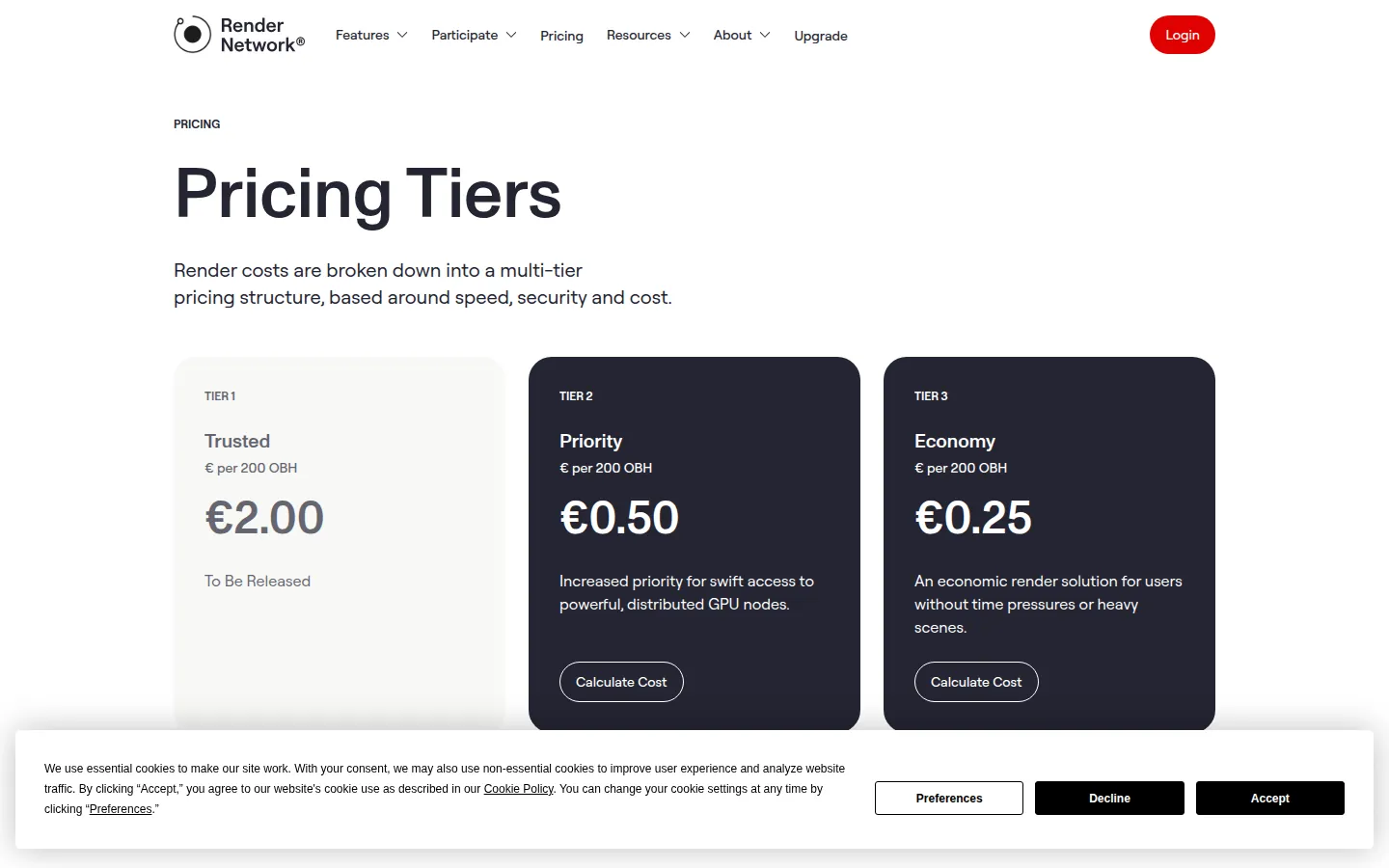
Pricing is not publicly listed in USD or per GPU-hour; instead, costs are estimated based on OctaneBench scores and per-frame render time, billed in RENDER tokens. There is no minimum spend, and payments are accepted only in RENDER. Fiat payments are not supported, and KYC requirements are unknown. This job-based model obscures direct cost comparisons with traditional cloud providers.
Render Network is a credible option for 3D and AI media creators already using OctaneRender or Blender, especially if you hold RENDER tokens. However, the lack of transparent, standardized pricing and hardware attestation means you should test with small jobs first. Not suitable for users needing predictable hourly rates or full GPU control.
| Documented price | see provider site |
|---|---|
| Payouts | per render job |
| Notes | Workload/frame-based pricing in RENDER/credits; no public $/GPU-hr table. Job costs are estimated from an OctaneBench score and measured per-frame time. Concrete rates not published and therefore omitted. |
Run the long math before paying: cloud mining calculator →
Ready to try Render Network? Start small, verify one payout, and only scale up once the hashrate or compute actually matches what you paid for.
Based on our checks as of 2026-09-24: Render Network scores 6.8/10 in our weighted review. We logged no red flags. User reports and operator background are documented with dated sources in the meta-review below.
You get rendered frames or completed media jobs processed by network GPUs, not raw compute time or hardware access. Work is billed in RENDER tokens based on complexity and OctaneBench performance.
Total cost depends on job size and GPU time, priced in RENDER tokens. No maintenance fee is listed, but exact rates aren’t public, and no fiat pricing table exists for comparison.
There is no minimum spend, so you can start with small jobs. However, there’s no formal trial or free tier - usage requires a positive RENDER token balance.
Payouts aren’t applicable to buyers; you pay per job. For node operators, earnings are in RENDER tokens per completed job, but supply-side income is not guaranteed.
If Render Network stops operating, your ability to render jobs ends. Since you don’t own hardware or tokens beyond your balance, any unused credits could be lost.
Buying hardware gives full control but high upfront cost. Render offers access without ownership. Compared to buying RENDER tokens, using them for rendering adds utility beyond speculation.

Host-set GPU marketplace with per-second billing; on-demand, interruptible and reserved tiers, plus serverless and clusters.

Open permissionless marketplace for containerised GPU/CPU compute; providers bid, tenants pay per block.
Distributed consumer-GPU cloud with published per-second prices and measured host earn rates; no token, fiat only.
No comments yet - be the first. Posting runs a short proof-of-work in your browser (anti-spam), no account needed.