Akash AKT
Thread about buying and staking AKT. Comments include long-term holders and provide-compute plans, but also 'dead shitcoin' sentiment and frustration over lower APR. Retrieved via pullpush.io.

Best-documented and most transparent of the six for raw container compute, with a live price API and a no-lock-in per-block market, but no provider SLA and no hardware proof-of-compute.
by the bestcloudmining editorial desk · review version 2 · prose updated 2026-09-24 · facts as of 2026-09-24 · how we verify
Akash Network is a permissionless GPU/CPU marketplace where providers bid to host containerized workloads, and tenants pay per second. It’s for developers and AI practitioners needing flexible, decentralized compute without long-term contracts. You get raw access via Docker, Kubernetes, or CLI, but there’s no SLA, and hardware performance isn’t cryptographically proven.
You can rent GPU and CPU compute across models like H100, H200, A100, RTX 4090, and T4, billed per second with no fixed term. Access is container-based via Docker, SDL, SSH, Jupyter, or API. You’re renting runtime, not hardware ownership or mining rights. You do not get physical access, TEE-secured execution, or guaranteed uptime - deployments depend on provider availability and network conditions.
Contracts are flexible with no fixed term (0-day duration), priced per second based on a reverse auction. There’s no maintenance fee, but escrow holds roughly two days of estimated costs. Payouts aren’t applicable - this is compute rental, not mining. Unused escrow returns to your balance when a deployment ends. No refund policy is stated for consumed compute, and minimum spend starts at $0.50.
Akash offers partial proof: on-chain lease and bid records are public, and provider capacity is published via API. The network attests provider configuration, but there’s no hardware-level proof-of-compute or trusted execution environment (TEE) for standard deployments. You can verify leases and pricing, but not that a provider ran your exact workload as intended.
Akash Network has a verified Apache-2.0 codebase and live APIs, with domain-verified GitHub repos and active 2026 development. No fraud allegations exist, though community sentiment is mixed and often tied to AKT token price. The operator is community/DAO-governed, originally linked to Overclock Labs. Data quality is verified, but provider reliability varies - success depends on individual node performance, not a centralized SLA.
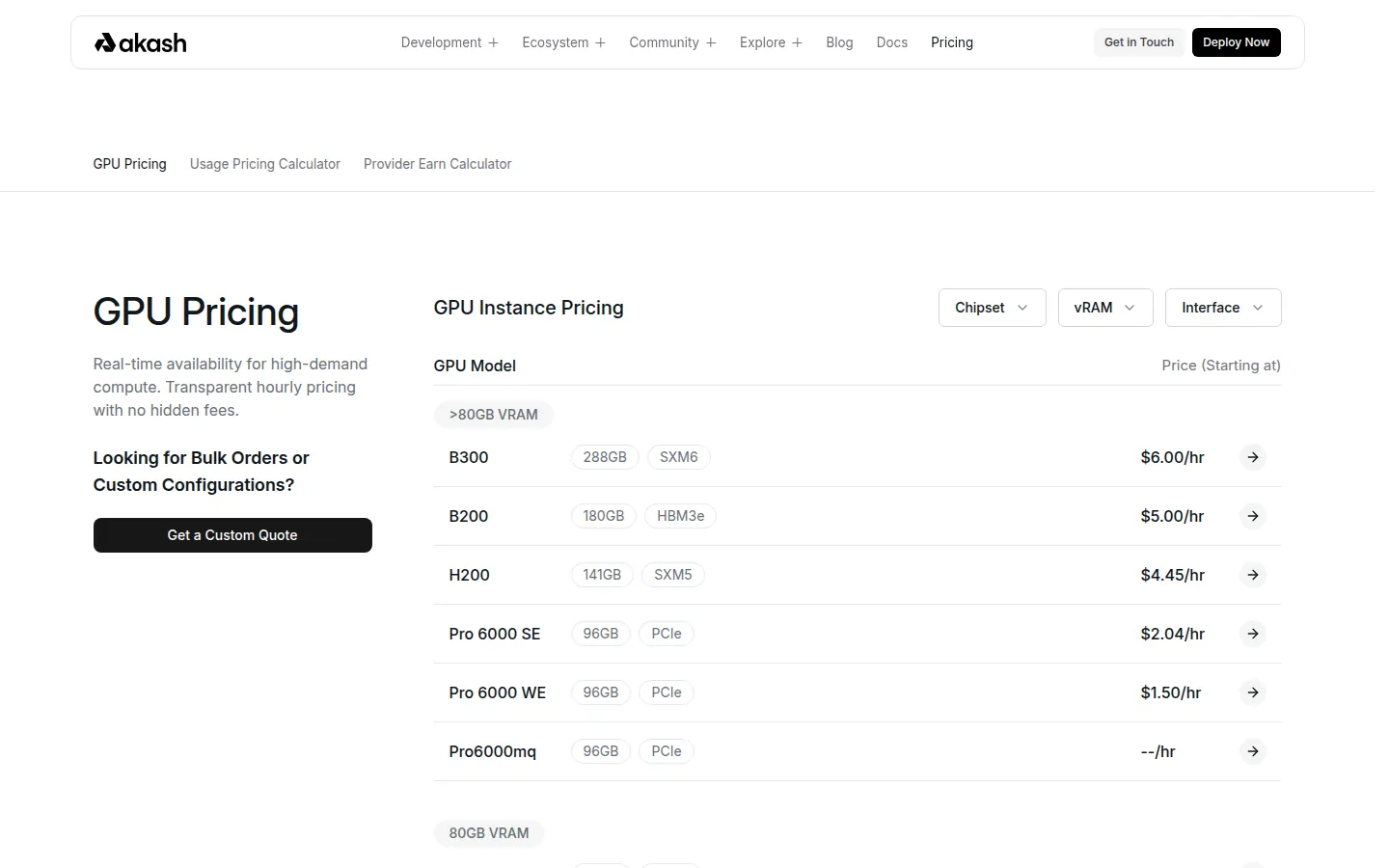
Pricing starts at $0.09/hour for RTX 3090-class GPUs, with H100 SXM5 units from $2.04/hour. You pay per second, with a $0.50 minimum deposit. Payments are in AKT or via fiat (credit card) through Akash Console, which converts to the internal ACT token. KYC is optional - Console requires email and card, but self-custody via wallet is available. Prices fluctuate hourly based on provider bids.
Akash is the most transparent and well-documented decentralized compute marketplace, ideal for developers comfortable with self-managed deployments and variable provider quality. It’s not for those needing guaranteed performance or hands-off infrastructure. For reliable, SLA-backed AI compute, consider centralized alternatives.
| Documented price | $0.090 per GPU/hr · $2.04 per GPU/hr (H100 80Gi SXM5 min) |
|---|---|
| Minimum | $0.500 |
| Payouts | continuously (per lease, AKT) |
| Notes | Live API 2026-09-24. Cheapest available class observed: RTX 3090 $0.09-0.17/hr. H100 SXM5 $2.04-3.16, H200 $4.45, A100 80Gi $1.07-1.91. Provider-set reverse-auction asks that move hourly; 134 of 469 listed GPUs available at capture. |
Run the long math before paying: cloud mining calculator →
Ready to try Akash Network? Start small, verify one payout, and only scale up once the hashrate or compute actually matches what you paid for.
Based on our checks as of 2026-09-24: Akash Network scores 7.2/10 in our weighted review. We logged no red flags. User reports and operator background are documented with dated sources in the meta-review below.
You get containerized compute time on GPUs like H100 or RTX 4090, accessible via SSH, Docker, or Jupyter. You don’t own hardware or get guaranteed performance - execution depends on the provider node.
You pay per second based on provider bids, starting at $0.09/hr for lower-tier GPUs. No maintenance fee, but escrow holds ~2 days of cost. Console converts fiat to ACT token; no hidden fees beyond usage.
Yes, minimum spend is $0.50. Akash Console offers free trial credits, and you can deploy without buying AKT if using the managed fiat path.
Payouts don’t apply - this isn’t mining. You pay for compute, not earn from it. Unused escrow returns when deployment ends; consumed time is non-refundable.
If the network fails, your deployments stop and escrow may be unrecoverable. Since it’s decentralized, risk is distributed, but no central entity guarantees continuity.
Renting avoids upfront hardware costs and scales flexibly, but lacks SLAs and consistent performance. Cheaper than some cloud providers for spot-like use, but less predictable than AWS or Azure.
Hybrid cloud+edge GPU marketplace with cheap consumer-GPU rates (RTX 3090 $0.14/hr, A100 $1.99/hr) and TFUEL-linked node rewards; cloud-launched in 2024. Facing an LA lawsuit alleging fraud/token manipulation.

Singapore-run GPU aggregator reselling capacity from 5+ neoclouds; H100 from $2.64/hr on-demand, per-minute billing.

Host-set GPU marketplace with per-second billing; on-demand, interruptible and reserved tiers, plus serverless and clusters.
No comments yet - be the first. Posting runs a short proof-of-work in your browser (anti-spam), no account needed.