The oldest decentralized-compute project still ships and is run by a clearly identified Swiss company, but it is developer-first with GLM-only payments, no public GPU price list, and a GPU provider programme that has stayed in beta since 2022 - useful for builders, not a turnkey GPU rental.
by the bestcloudmining editorial desk · review version 2 · prose updated 2026-09-24 · facts as of 2026-09-24 · how we verify
Overview
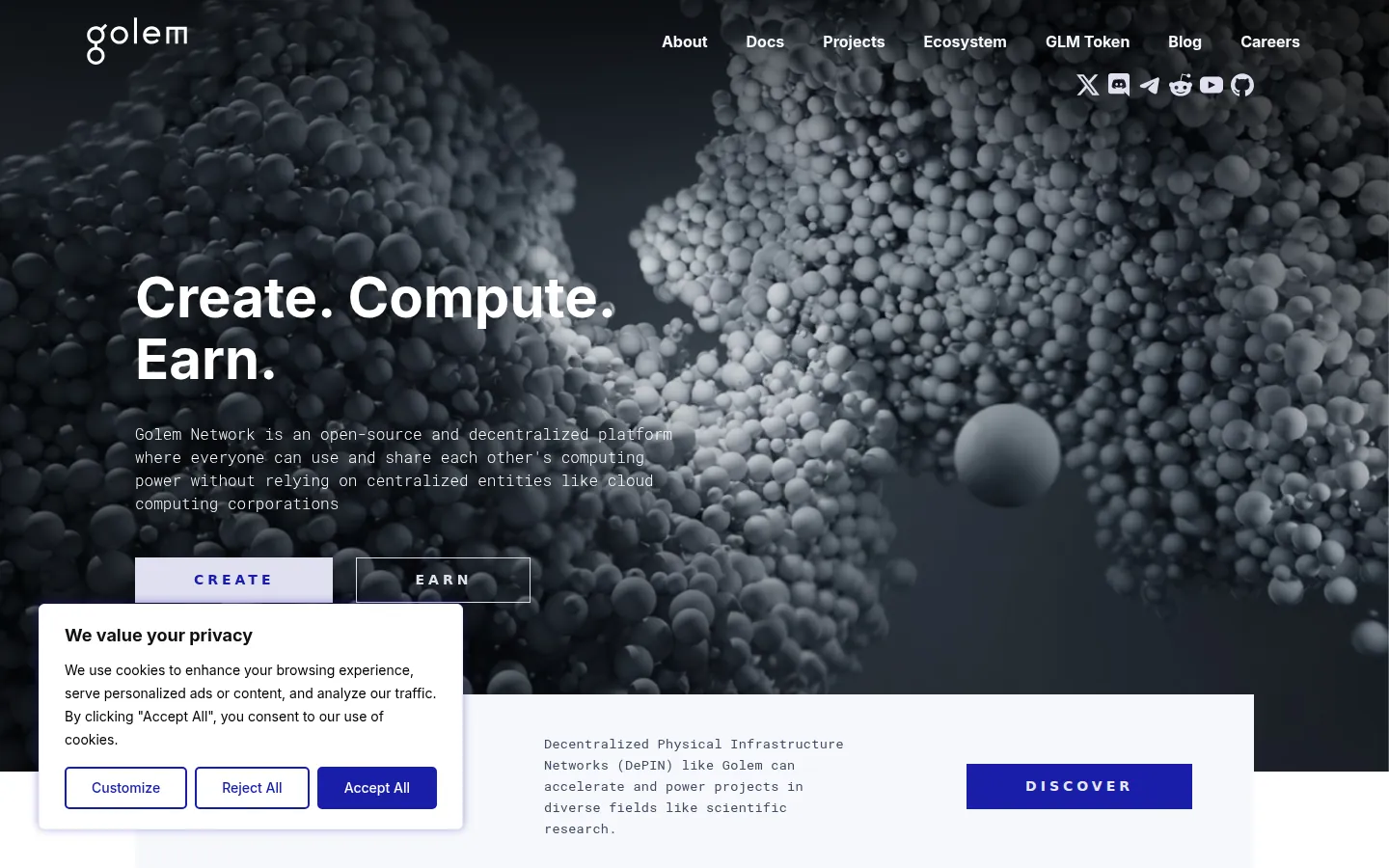
Golem Network homepage - live capture 2026-09-24
Golem Network is a Swiss-based decentralized compute platform launched in 2016, focused on CPU-first distributed computing with a long-running but still-beta GPU provider program. It caters to developers and technical users who want to run compute tasks via SDKs or CLI, paying in GLM tokens. While it’s one of the oldest DePIN projects and operates transparently under Swiss jurisdiction, it lacks public GPU pricing and a mature, self-serve rental interface.
What you can rent
You can rent decentralized CPU and limited GPU compute resources through Golem Network, though GPU availability remains in beta since May 2022 with no published list of supported models or guaranteed access. Compute is accessed via developer tools like JS/Python SDKs, CLI, Docker, or Ray. You pay in GLM for task-based execution, not fixed rental periods. You do not get dedicated hardware, self-serve GPU instances, or guaranteed performance SLAs.
Contract & terms
Contracts are per-task, with no fixed term - execution happens only when a provider matches your request. Pricing is set by individual providers in GLM per hour (default CPU rate shown as 0.025 GLM/hour + fees), but GPU rates are undocumented. There is no stated maintenance fee, refund policy, or uptime SLA. Minimum purchase and payout thresholds are unspecified, and the model relies on provider reputation and task verification rather than formal guarantees.
Proof & verifiability
Golem offers partial proof: payments settle on Ethereum and Polygon mainnets, providing on-chain transparency for GLM transactions. Task results are verified through a reputation system and provider selection criteria (price, cores, node ID), but there is no universal hardware attestation or Trusted Execution Environment (TEE) to confirm GPU usage. The lack of public GPU pricing or real-time provider stats limits verifiability of actual compute delivery.
Reliability & history
Golem Network is operated by Golem Factory GmbH, a registered Swiss company, and has maintained continuous operation since 2016. It’s respected as a pioneer in decentralized compute but has lost momentum to AI-focused competitors like Akash and io.net. Reddit activity is minimal, and the GPU program remains undocumented since its 2022 beta launch. Facts are reported, not independently verified, so small test tasks are advised before large commitments.
Pricing
Pricing is set by providers in GLM, with no public USD equivalent or standardized GPU rates. The default CPU rate is 0.025 GLM per hour plus an environment fee, but GPU pricing remains undocumented. Payments are accepted only in GLM (ERC-20 on Ethereum/Polygon), with no fiat on-ramp. KYC is optional but may be enforced for network access. Without a clear price list, cost comparison is difficult and depends on provider settings and GLM’s market value (~$0.1223 as of 2026-09-24).
Verdict
Golem Network is a legitimate, long-standing decentralized compute platform best suited for developers comfortable with SDKs and token-based payments. It’s not a turnkey GPU rental service - avoid if you need predictable pricing, immediate GPU access, or simple self-serve infrastructure. For most users, newer AI-optimized networks may offer better usability and transparency.
++ What works
Pioneer with the longest track record in decentralized compute (2016) and a clean, identified Swiss legal entity
Open-source Yagna stack with JS/Python SDKs and Ray-on-Golem for distributed workloads
Provider-set pricing means a provider can compete on price
On-chain GLM settlement on Ethereum and Polygon
-- What to watch
No public $/GPU-hour pricing; the GPU provider programme is still a beta from 2022
GLM-only - no fiat self-serve checkout
Developer-first: not a one-click SSH GPU box
Little current community activity; GPU utilisation is unverifiable
Pricing reality check
Documented price
see provider site
Notes
No public $/GPU-hour table exists; pricing is provider-set in GLM. Default provider pricing shown in the docs is 0.025 GLM per CPU-hour plus 0.005 GLM per hour environment fee (and a configurable start fee). A GPU-provider programme launched in beta in May 2022 but is not documented with current rates. docs.golem.network/pricing returns 404.
Based on our checks as of 2026-09-24: Golem Network scores 5.4/10 in our weighted review. We logged no red flags. Facts are reported, not fully verified - test with a small purchase and a withdrawal first. User reports and operator background are documented with dated sources in the meta-review below.
What do I actually get when I rent from Golem Network?
You get access to decentralized CPU or limited beta GPU compute for running tasks via SDKs or CLI. You don’t own hardware, and availability depends on matching provider resources. Tasks are billed per hour in GLM, with no guaranteed performance or uptime.
What are the total costs and fees?
You pay providers in GLM per task hour, with default CPU rates of 0.025 GLM/hour plus 0.005 GLM/hour environment fee and a configurable start fee. GPU rates are not publicly documented. No maintenance fee is listed, but GLM price volatility and provider markups affect total cost.
Is there a minimum purchase or trial option?
There’s no stated minimum purchase, allowing small or test tasks. Since pricing is per-task and set by providers, you can start with low-cost jobs. However, without a public price list, exact costs must be discovered through trial execution.
How do payouts work for providers?
Providers earn GLM tokens settled on Ethereum or Polygon mainnet when tasks complete and pass verification. Payouts are automatic and on-chain, with no stated threshold or frequency. Requestors pay upfront in GLM, which is held until task completion.
What happens if Golem Network shuts down?
If the network or company ceases operation, the decentralized provider pool may continue running, but support, updates, and task coordination could fail. Your GLM balance remains on-chain, but you may lose access to compute functionality unless the open-source tools are maintained by the community.
How does renting compute on Golem compare to buying hardware or cloud services directly?
Golem offers decentralized, developer-first compute without upfront hardware costs, but with less predictability than AWS or bare-metal providers. Compared to buying GPUs, it avoids capex but introduces latency and compatibility risks. For AI workloads, newer platforms often provide better tooling and pricing clarity.
// The meta-review: what the internet says about Golem Network
We do not expect you to trust us. This review is a meta-review: below you see what other review sites claim, what users report on Reddit, forums and complaint boards, and who actually operates Golem Network. Every claim links to its source so you can verify it yourself. Our verdict forms from these sources plus our own fact checks - not the other way around.
// What other reviewers say (0)
Heads-up: most cloud mining "reviews" are affiliate content. We mark our reliability judgement on every source and include critical voices deliberately.
No third-party reviews with usable evidence found yet. In this niche that is itself a signal - most "review" sites are paid placements.
// What users say (1)
Reddit, forums, complaint boards. Anecdotes, not proof - but payout complaints and host-reliability patterns are the best early-warning system this market has.
The most recent organic post surfaced in pullpush is a low-engagement subtask-comparison post (1 upvote, 0 comments). The subreddit shows very little current activity, consistent with Golem's ceded mindshare. Found via pullpush.io.
// Who is behind Golem Network?
Cloud mining ownership is often deliberately opaque. This is what we could verify - with sources. Confidence: high (checked 2026-09-24).
Operator
Golem Network
Legal entity
Golem Factory GmbH
Registered in
Switzerland
Other sites run by the same operator/network:
Golem
Golem Network
Yagna
Golem Factory GmbH is registered at Gartenstrasse 5, 6300 Zug, Switzerland (per Privacy Policy). One of the oldest decentralized-compute projects (predecessor 2016; Golem Factory GmbH later). It markets itself as a DePIN platform for sharing CPU/GPU and is developer-first rather than a self-serve GPU rental shop.
Every external source used on this page, with the date we fetched it. Methodology: how we verify. Sources disappear or change - if a link is dead, tell us via contact.
A network of subnets producing digital commodities and paid in TAO - not a GPU-rental market; buyers rent compute indirectly via subnet apps such as Chutes (subnet 64).


No comments yet - be the first. Posting runs a short proof-of-work in your browser (anti-spam), no account needed.